Correspondence regarding Emancipation Proclamation celebrations, 1863
HISTORICAL CONTEXT
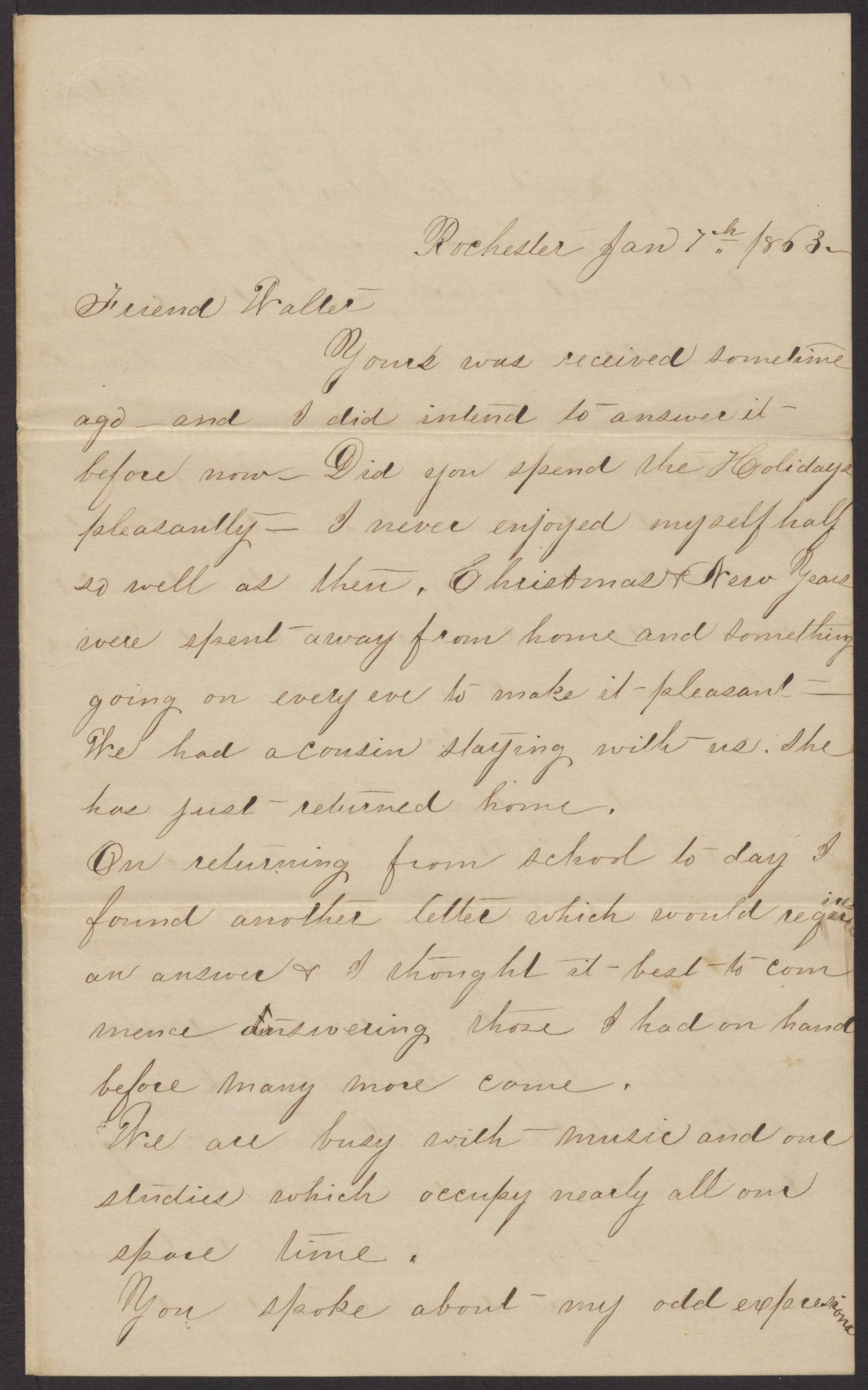
This four-page emancipation-proclamation-era letter, written on January 7, 1863, describes the ordinary days of a person named Hillie in Rochester, New York. Christmas and New Year celebrations had passed, and Hillie wrote to a friend about the pleasant holiday celebrations and the state’s snowy weather. A week before, Abaraham Lincoln issued the Emancipation Proclamation on New Years Day, an executive order which declared that the enslaved people in the Confederate South were to be freed. In a brief mention, Hillie reacted by writing, “it must have been rejoicing at the liberation.” What rejoicing meant to Hillie remains unclear, but a publication of the New York Herald on January 1, 1863, revealed the expectation that many abolition conventicles would “make it a day of jubilee” in celebration.
This was at a critical time before the end of the Civil War—the nation was divided among itself, and what ‘freedom’ meant for those enslaved was uncertain. Hillie detailed the experience listening to Reverend M.D. Conway speak just “a week ago. ” Moncure D. Conway was an abolitionist, minister, and writer from Virginia. Before Hillie’s encounter, Conway had published The Question of the War on September 13, 1862. His work alluded to the constitutional error that allowed the institution of slavery under the guise of property rights. In the article, he described enslavement as the "meanest, foulest injustice.” When Hillie heard Conway speak a week before writing this letter, ‘grand’ was used to describe the experience. Despite being grand, not all were rejoicing. Hillie observed that democratic party members in attendance were “disgusted as they did not remain till he had finished.”
The emancipation era was intertwined with the day-to-day of 19th -century northern life. What one called ‘rejoicing,’ another appeared ‘disgusted.’ Hillie’s letter was at the cross-section between slavery and freedom, reminding us to bear witness to Lincoln’s proclamation and the everyday lives it influenced.
View Original Document
|
 |

